| Home | Introduction | Research | Software | Community | News |

Introduction
Economic Resource Management
The proven ability of a free-market economy to adjudicate and satisfy the diverse and sometimes conflicting needs of millions of human agents in ever changing environ-ments, makes it a clear prospect as an autonomic resource allocation principle [1]. A computational system set up along market rules can allow the system as a whole to adapt to changes in the environment or disturbances to individual members.A salient property of markets is its ability to arrive at a state of coordinated actions, the "spontaneous order”, through the local bartering and communication of partici-pants who behave under incomplete information and bounded rationality. The market here is nothing more than a communication bus – it is not a central entity of its own and does not participate in matching participants’ requirements using some opti-mization mechanisms. One central concept of this model is that of constitutional ignorance, assuming that it is impossible to have global knowledge of the market. These properties make markets particularly well suited to address the issues of autonomic computing.
More specifically, microeconomics provides three tools to achieve a self-adaptive coordination of actions: decentralization, competition and a pricing system. Decentralization and competition solve the problems caused by scale, heterogeneity and diversity. It is no longer necessary to define a common system goal that adequately reflects the wants and desires of the diverse community. It is simply necessary to un-derstand the goals of the individuals, and the economic competition computes a system state that is ”optimal” with respect to the community of users.. All decisions are made independently, and there is no need for agents to collaborate on improving the system as a whole. Prices serve as surrogates for the underlying knowledge of agents. Competitively determined market prices enable actors to adjust to the knowledge and pref-erences of other actors, so as to best achieve each one’s goals.
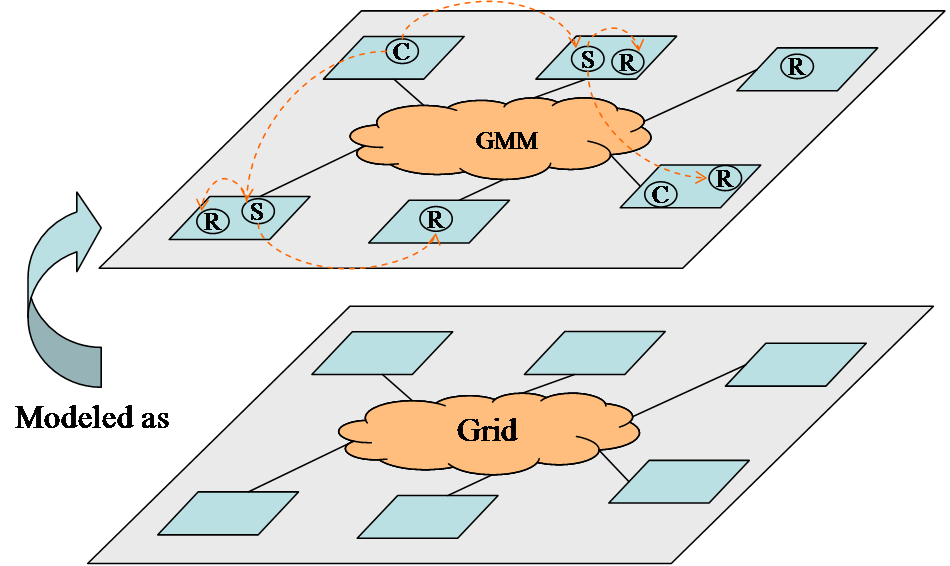
Based on these economic concepts, we have envisioned a grid resource allocation model based on of autonomous economic agents (representing the Client Applications, Services and Resources of the grid) that interact between them to coordinate, in a decentralized way and using economic criteria, the assignment of resources, as can be seen in the Figure 1. Direct agent to agent bargaining allows participants to use the negotiation strategy more suitable to its objectives and current circumstances. Local bilateral bargaining also facilitates the scalability of the system and the quick adaptation to fluctuations in resource allocation dynamics.
Figure
1 - A conceptual model for the GMM
Objectives
of GMM
Architecture
The economic based resource allocation model has been implemented in the Grid Mar-ket Middleware (GMM), which provides the mechanisms to register, manage, locate and negotiate for services and resources. It allows trading agents to meet each other based on its requirements and engage in negotiations. Furthermore, the middleware offers a set of generic negotiation mechanisms, on which specialized strategies and policies can be dynamically plugged in. The middleware – as shown in Figure 2 – has a layered architecture, which allows a clear separation of platform specific concerns form the economic mechanisms, to cope with highly heterogeneous environments.
Figure
2 Layered middleware architecture
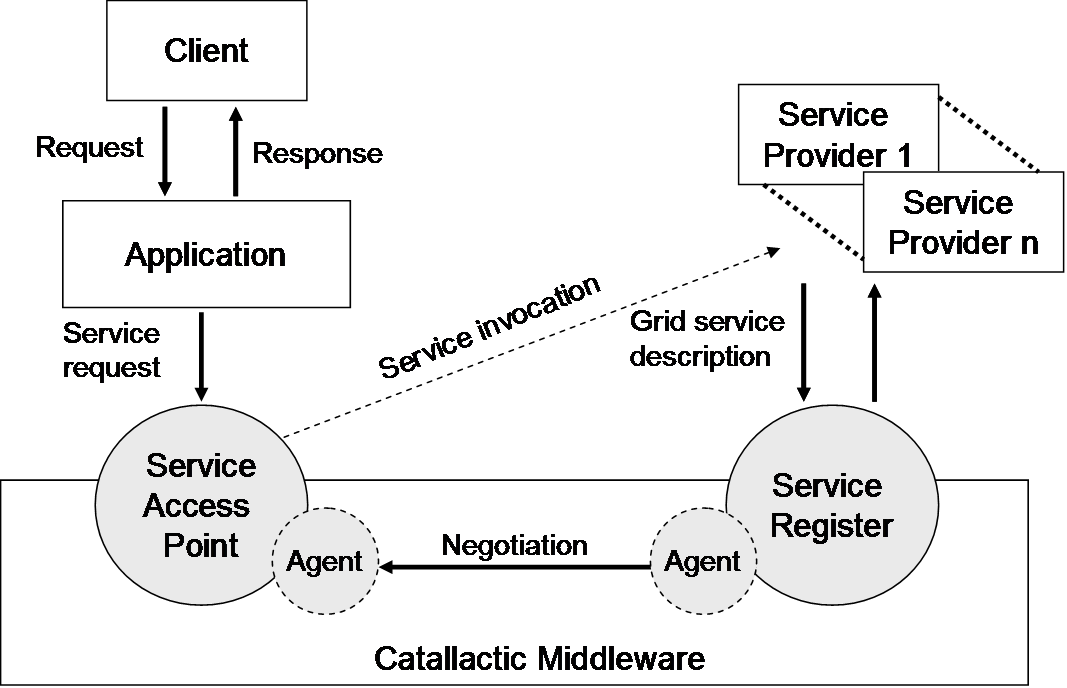
Applications interact with the Grid Market Middleware in order to obtain the Grid services required to fulfill the application tasks. The Base Platform supports the appli-cation by providing a hosting environment for the Grid services. Figure 3 describes the main steps in this interaction. When a client issues a request, the application determines which grid services are required to fulfill it. These grid services represent either soft-ware services (e.g. a data processing algorithm) or computational resources. The application service translates these requirements to a grid service request, which is submitted to the Grid Market Middleware. The middleware searches among the available service providers, which have registered their particular service specifications, like contractual conditions, policies and QoS levels. When a suitable service provider is found, the application requirements are negotiated within the middleware by agents who act in behalf of the service pro-viders as sellers and the application as buyers. Once an agreement is reached between the trading agents, a grid service instance is created for the application a reference is returned to the application, which can invoke it.
Figure
3 Application integration.
Implementation
References
(c)Technical University of Catalonia 2006
Last update August 18, 2006